The Avon rewards patience. Stand still on a towpath in January and you may see nothing but a grey heron pretending to be a fence post. Return in May and the same bend can be loud with warblers, with a kingfisher flashing downstream. Birds follow the river's calendar: food, nesting cover and water levels shift month by month, and so do the species you meet. Here is what to look for through the year.
Spring: song, nests and the first flash of blue
From late February the river starts to feel busy. Grey herons are among the earliest nesters; if one is carrying sticks to a tall tree across the water, there is probably a heronry nearby. Mute swans rebuild nests on quiet banks and in backwaters, often in the same place year after year.
By March the willows are alive with chiffchaffs, whose two-note song is easy to learn and follow. Blackcaps arrive a few weeks later, singing from scrub and alder. Look for grey wagtails bobbing on weirs and mill races, and listen for the sharp tick of a kingfisher before you see it. A kingfisher nest is a tunnel in a vertical bank, and pairs often return to the same stretch. Watch for low, fast flight over the water rather than a bird sitting in the open.
Walk slowly upstream in the early morning, keep the sun behind you, and pause at every bend before you appear over the top of the bank. Birds see you long before you see them.
Summer: cygnets, young kingfishers and the green tunnel
By June the banks have closed in and the river feels like a green corridor. Mute swans are the headline act, with cygnets on the nest or on the water; give a hissing cob plenty of room. Kingfishers are busy feeding young and often easier to see now because they must work harder for food. Look for one perched low over a shallow, gravel-bottomed run. Herons are more relaxed, standing motionless in the shallows for half an hour at a time.
Dawn is still worth the alarm, though song fades by mid-morning. In warm spells, watch for a hobby hunting insects over the water — a small falcon dashing and pivoting, eating dragonflies on the wing.
Autumn: passage birds and gathering swans
September and October bring movement. Swallows and house martins line up on wires and bridges before heading south, and sand martins appear over gravel shallows. Common and green sandpipers pause on muddy margins and gravel bars, bobbing their tails as they feed.
Mute swans gather in larger groups, and young birds from the summer's broods begin to appear on their own. Kingfishers are quieter and less territorial now; a sheltered pool below a weir is a good bet, because small fish stay active in colder water.
The banks thin out, too. Views you lose in June are handed back in November.
Winter: the quiet specialists
Cold weather changes the cast. Goosanders — long, slim, red-headed diving ducks — arrive on larger stretches, often in loose groups. Cormorants stand on posts with wings held out to dry. Little grebes dive in the slower water, and you may glimpse a water rail slipping through reeds at the edge of a backwater.
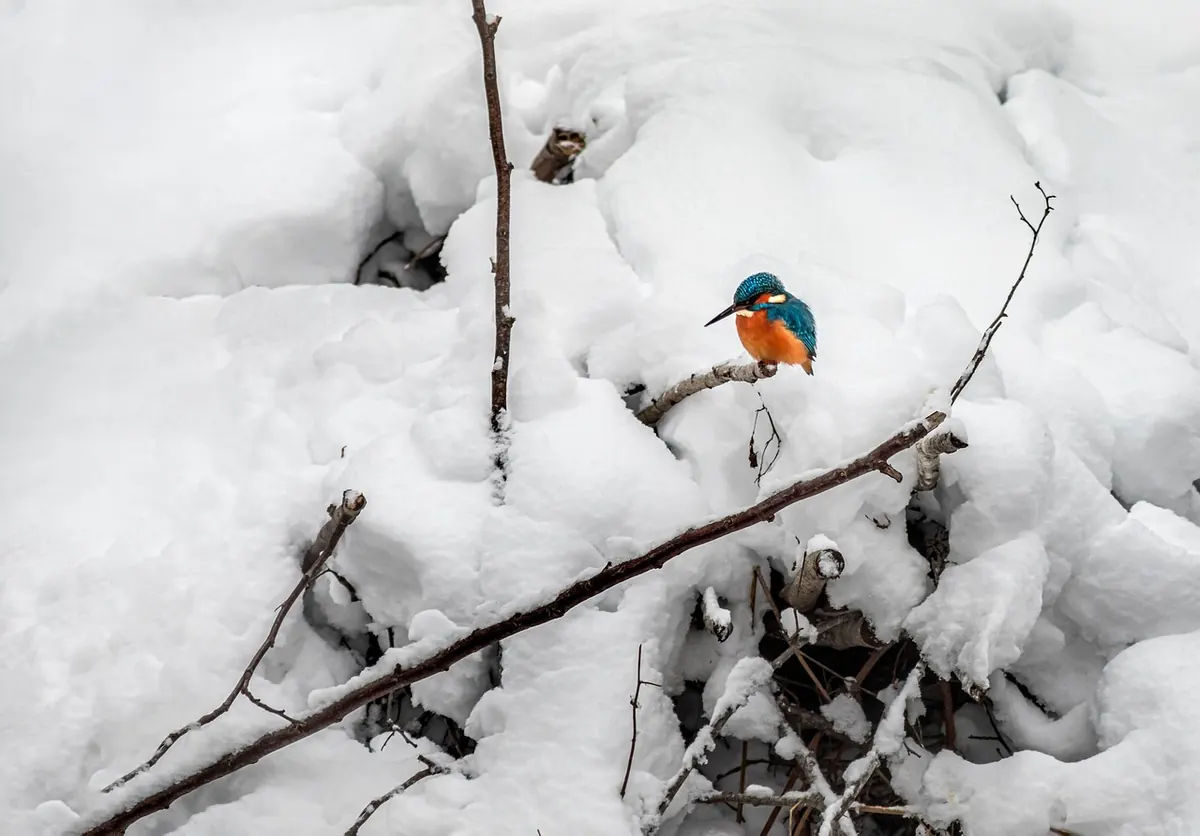
Grey herons become almost domestic, standing on frozen margins and garden walls. Kingfishers can be surprisingly reliable in winter, since they must fish more often and open water concentrates their prey. With the trees bare, a heron on a high branch is easy to spot from a distance.
The three to know: kingfisher, heron, swan
Kingfisher
A small, compact bird with a short tail, a large head and a dagger bill. In good light the back is brilliant blue, but in shade it can look dark and almost black. Listen first: a sharp, high whistle, usually carried over the water as the bird flies fast and low. Watch for the perch, then the plunge — a vertical dive into the water, often from a low branch over a shallow run. Never approach a nesting bank; a disturbed pair can abandon it.
Grey heron
Tall, grey and instantly recognisable, with long legs and a folded neck that can strike faster than you expect. Herons hunt by standing and waiting, so scan the shallow margins and then stop moving. A heron that has seen you will often fly off with slow, heavy wingbeats, usually calling a harsh kraank. If you find a heronry in winter, enjoy it from a distance and avoid lingering under nesting trees in spring.
Mute swan
The largest bird you are likely to see on the Avon. Adults are white with an orange bill and a black knob at the base; juveniles are a dull grey-brown. Mute swans are not mute — they hiss, grunt and snort, and the wings of a flying swan make a loud, rhythmic throbbing. Give them room, especially with cygnets, and avoid feeding bread to wildfowl; it adds little and can foul the water.
Where to look along the river
Birders often make the same mistake: they walk the same straight stretch and see the same three mallards. The Avon rewards you for reading the water. Different birds want different features, and a short walk can offer all of them.
- Weirs and mill races: grey wagtails, kingfishers and cormorants. The broken water holds small fish and insects, and the noise masks your approach.
- Shallow gravel runs: kingfisher perches, sandpipers in autumn, and herons in summer. Look for a branch overhanging the water with a clear drop below it.
- Steep earth banks: possible kingfisher nest tunnels. Watch from the opposite bank or from a distance, and keep moving.
- Backwaters and reed edges: water rails, little grebes, moorhens and warblers. Quiet, slow water with cover is the place to stand still.
- Open water and lakes: goosanders, tufted ducks, cormorants and swans in winter. Early morning is best, before boats and dog walkers arrive.
- Alder and willow lines: blackcaps, chiffchaffs, siskins and redpolls. Listen for small calls above your head.
Practical notes for a day on the Avon
Go early. The first two hours after dawn are reliably the best, and the river is quieter than it will be later. Take binoculars you can hold steady, a notebook or phone for notes, and clothing that keeps you warm while standing still — a waterproof jacket and boots matter more than a long lens.
Move slowly, stop often, and use cover: a hedge, a tree trunk, a bridge parapet. Scan ahead, then step forward. When you find a good perch or pool, wait. Most of the best sightings come from staying put for fifteen minutes rather than covering more ground.
Respect the river and the birds. Keep dogs close and out of the water in nesting season, stay on public paths, and avoid disturbing banks where kingfishers or sand martins may be nesting. If you are walking alone on remote stretches in winter, tell someone your route and carry a phone; muddy banks and cold water are the real hazards, not the wildlife. For anything involving access, fishing rights or protected species, check with the local river trust or the landowner before you go.
Photo: Erik_Karits / Pixabay