The Avon is not a wild river, and has not been for a very long time. Paddle a stretch between two market towns and you pass a sequence of structures — a low stone weir, a dry channel running behind the trees, a brick arch with an iron frame still bolted into it, a pool oddly wide for the river around it. Every one of those was built to do work. Knowing what they are changes the day: you read the water earlier, you pick your landing better, and you notice things most people drift straight past.
The Anatomy of a Mill Site
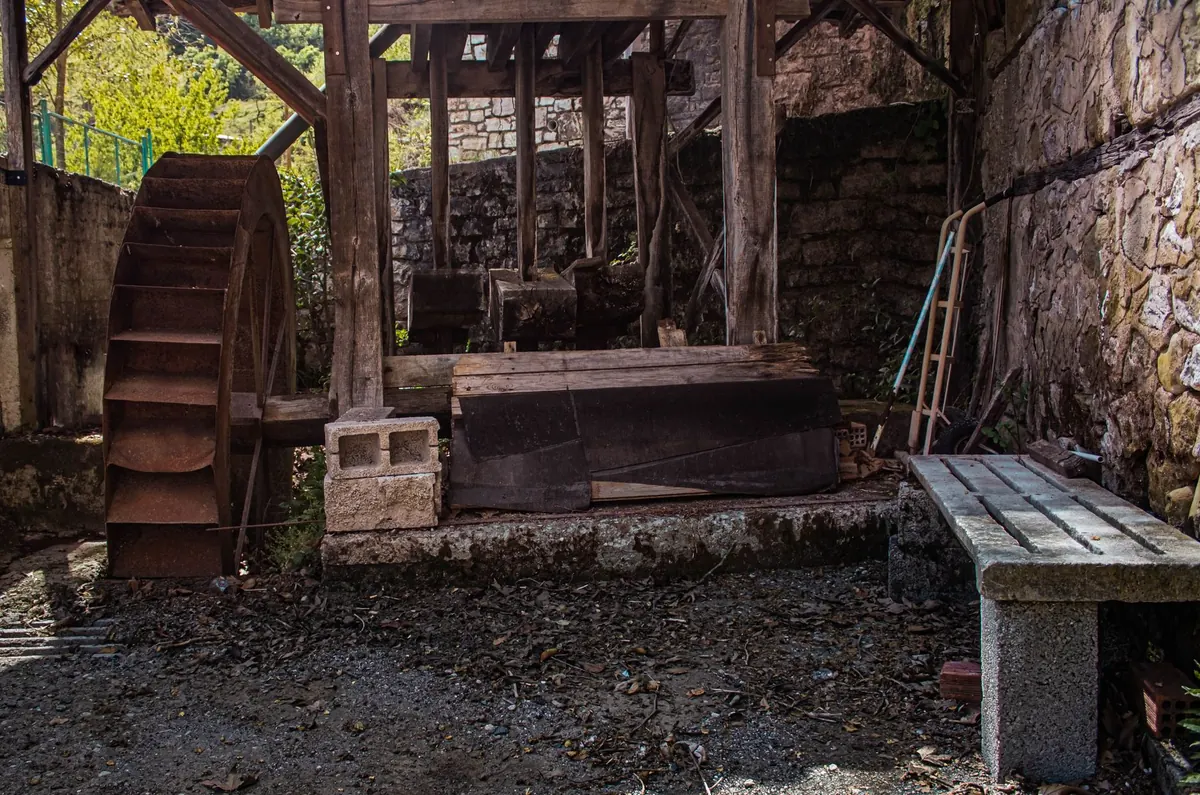
Almost every weir on the Avon exists because a mill needed height. A waterwheel only turns if water falls onto it or rushes beneath it, so the miller raised the river level with a barrier, then cut a channel to carry that water to the wheel. What you see from a kayak or canoe is the outside of that system. The vocabulary is worth learning, because it tells you what to expect as you approach.
- Weir — the barrier itself. Straight, diagonal or horseshoe-shaped, in stone, timber, concrete or a mix of all three.
- Head race, leat or millrace — the channel feeding the mill, usually on one bank only. Often dry now, sometimes a shallow brook running through a garden.
- Millpond — the pool behind the weir, holding water back for the wheel and evening out the flow.
- Sluices — gaps with gates, frames or rack bars that controlled how much water went where.
- Tail race — where water left the wheel and rejoined the river, usually just downstream of the weir.
- Wheel pit and mill building — sometimes vanished, sometimes a cottage, sometimes a converted flat with river views.
Weirs Are Not Dams
A reservoir dam holds water back; a mill weir mostly raises it a metre or two and pushes the surplus over the top. That is why so many Avon weirs look modest in summer and unrecognisable after heavy rain. The structure doesn't change — the river does. A gentle drop of thirty centimetres in August can be a thundering, recirculating mass in February, with the whole floodplain carrying water and no obvious line anywhere.
Some weirs on the river were built for navigation rather than milling, and some were rebuilt by the navigation trusts after decades of neglect. The Avon was made navigable, silted up, fell out of use and was restored largely by volunteers in the second half of the twentieth century. That history explains the odd mix you'll meet: a tidy lock with a weir beside it, then a tumbled mill site two bends later.
What the Drop Does to Your Boat
Water going over a weir curls back on itself at the base. That recirculation is what paddlers call a towback or keeper hydraulic, and it is the single most important thing to judge from upstream. Stop well above the weir and look at three things: the line of the lip, the boil below it, and the banks.
- A smooth, glassy approach with a clean, unbroken lip usually means the strongest recirculation.
- Broken, noisy water with visible stone is often less retentive — but shallow, and a bad place to swim.
- Eddies at either end of the weir are your friends. They give you a place to stop, land and look.
- Upwellings and sideways boils downstream often mark a tail race emptying in. They can shove you off line.
Reading the Industrial Leftovers
Once you know what to look for, a stretch of river becomes a set of clues. Dressed stone blocks with tool marks. Iron sluice frames, sometimes with the rack bars still in place, half-swallowed by nettles. A straight, stone-lined channel running parallel to the river for a hundred metres and then stopping. A house with a wide arched ground floor — that arch was the wheel. Stone steps at the water's edge, built for loading boats. And names: Mill Lane, Mill Cottage, The Old Mill, Weir Meadow.
You will find these features on almost any stretch with a village on the bank. The mill at Charlecote, near Hampton Lucy, is still a working watermill and one of the clearest examples of the whole system in one place. Around Warwick, the weir by the Saxon Mill has been photographed more times than anyone could count. Stratford's weirs sit right against the town, and the mill sites at Evesham, Pershore and Fladbury mark the same pattern: village, mill, weir, bridge, all within a few hundred metres of each other. Where the river was navigable, locks and weirs often stand side by side — one for commerce, one for power.
Passing a Weir Without Drama
Scout anything you don't know. On a new stretch, get out a bend upstream and walk the bank to look at the weir and the portage together, because the easy get-out is often on the opposite side to the easy get-in. Portage on the upstream side wherever you reasonably can; carrying a boat up through the boil of a weir is far harder than carrying it down a slope.
When you portage, take the boat out bow-first, keep it level and use a painter if the bank is steep or muddy. Don't stand in a tail race to launch — the flow pulses unpredictably, and the stones are slick. Wear a buoyancy aid even on flat water, and on anything above a modest winter level treat every weir as a decision rather than an obstacle to be run.
Give anglers a wide berth and a greeting. Coarse fishing is popular along much of the Avon, and many stretches are leased by clubs, so a cheery hello and a slow, quiet pass keeps everyone onside. Avoid wading or launching on clean gravel shallows in the spawning months, and keep off banks that are clearly private gardens. Access arrangements vary from stretch to stretch and are worth checking locally before a trip.
Before You Launch: A Short Checklist
- Identify the weirs on your route before you go, and mark which ones have a usable portage and on which bank.
- Check the river level and the forecast; a rising river turns a simple portage into a difficult landing.
- Scout from the bank on any weir you have not seen with your own eyes.
- Carry a painter, a throwline and warm spare clothing in a dry bag.
- Tell someone your get-out and your likely time back.
- Check access and fishing rights with the local navigation trust or angling club.
The structures on the Avon were built for people in a hurry to grind corn, full cloth or turn a wheel. They are still doing something: shaping the current, choosing where the deep water sits, deciding where you stop. Learn to read them and the river stops being scenery and starts being a place with a working past — one you can paddle through in an afternoon.
Photo: Teo Doulke / Pexels